


9 Ways to Improve Your Grain Storage System


A grain storage system that worked well when it was first built may not be the best fit for your operation today.
Acreage changes. Yields increase. Equipment gets larger. Harvest moves faster. Storage needs grow. Before long, a system that once kept up can start creating bottlenecks at the pit, dryer, conveyor, bin, or load-out.
Improving your grain system doesn't necessarily mean tearing everything out and starting over.
Sometimes the right solution is additional storage. Other operations may benefit more from improved aeration, a higher-capacity conveyor, better monitoring, upgraded drying equipment, or changes to how grain moves through the facility.
At RidgeTop Farm Supply Inc., we provide consultation, design, equipment sales, construction, installation, maintenance, and repairs for grain storage and handling systems throughout Missouri, Southern Iowa, and Eastern Illinois.
If you're looking for ways to make your current setup work better, these nine areas are a good place to start.
1. Start With Professional Grain Storage & Handling System Design
Before buying another piece of equipment, look at the entire system.
Every part of a grain facility affects another part. Increasing the capacity of one conveyor won't accomplish much if the grain leg behind it can't keep up. Adding bins without thinking about how grain will reach them can create additional handling challenges. Installing a larger dryer may simply move the bottleneck farther down the line.
That's why good grain-system design begins with understanding how your operation actually works.
At RidgeTop, we consider factors such as:
Crop mix and acreage
Current and expected yields
Harvest speed
Existing storage capacity
Grain dryer capacity
Grain handling capacity
Truck and equipment traffic
Load-in and load-out requirements
Existing equipment
Plans for future expansion
From there, we can develop a grain system layout designed around the operation rather than trying to make the operation fit the equipment.
With more than 60 years of combined experience, our team understands how bins, dryers, conveyors, grain legs, unload systems, aeration equipment, and controls need to work together.
2. Upgrade Aeration & Drying
Protecting grain quality doesn't end when the bin is full.
Your drying and aeration systems play an important role in maintaining the condition of stored grain.
If your current drying equipment struggles to keep up with harvest, upgrading your dryer may allow you to harvest at higher moisture levels while improving overall throughput. A properly planned drying system can also give you more control over when grain comes out of the field.
RidgeTop supplies, installs, services, and maintains GSI grain dryers, including Mixed Flow and Tower Dryer options.
Aeration deserves the same attention.
Fans, transitions, ducts, controls, and other components should be appropriately sized and maintained for the storage system. Improving aeration can give you better control over stored-grain conditions and help protect the crop you've already worked all season to produce.
The key is looking at drying and aeration as parts of the complete storage system—not as separate pieces of equipment.
3. Add Automation & Monitoring
You can't stand beside every bin, conveyor, motor, and dryer around the clock.
That's where monitoring and automation can help.
Depending on the facility, modern controls and monitoring equipment can provide better information about system operation and stored-grain conditions. Automation can also help coordinate equipment and simplify repetitive processes.
For some operations, improvements may include temperature or moisture monitoring, bin-level monitoring, equipment sensors, alarms, or automated controls.
RidgeTop also offers products such as LevAlert grain bin level monitoring systems along with other equipment that can help improve grain-system management.
Technology doesn't replace good management, but the right information can help you make better decisions sooner.
4. Increase Storage Flexibility
More storage capacity can create more options.
Instead of being forced to move grain simply because you've run out of room, additional on-farm storage may provide greater flexibility in how you manage harvest and market your crop.
But adding storage isn't just about putting another bin wherever there's space.
Think about how additional capacity will affect:
Grain flow
Conveying equipment
Dryer capacity
Aeration
Electrical requirements
Traffic patterns
Load-out
Future expansion
RidgeTop supplies and installs GSI grain bins and can help plan bin additions as part of the larger facility.
The goal isn't simply more bushels of storage. It's usable capacity that works efficiently with the rest of your system.
5. Strengthen Preventative Maintenance
Sometimes the best grain-system improvement isn't new equipment.
It's taking better care of what you already own.
Preventative maintenance can help identify worn belts, bearings, auger flighting, buckets, gearboxes, motors, controls, dryer components, and other issues before they become harvest breakdowns.
Regular maintenance should also include inspection of bins, structural components, aeration equipment, unload systems, conveyors, grain legs, electrical controls, and other parts of the facility.
RidgeTop offers seasonal maintenance, inspections, repairs, service, and replacement parts to help keep existing grain systems working.
A dependable system isn't just designed well. It's maintained well.
6. Optimize Load-In & Load-Out Speed
How quickly can you get a truck unloaded during harvest?
How efficiently can you load grain back out when it's time to move it?
Those two questions can reveal a lot about your grain system.
Slow load-in can leave trucks waiting and affect how quickly grain gets away from the field. Slow load-out can cost time later when you're trying to move stored grain.
Improving throughput may involve changes to:
Grain conveyors
Bucket elevators and grain legs
Augers
Unload systems
Spouting
Slide gates
Material handling equipment
Equipment controls
RidgeTop works with equipment from manufacturers including GSI, Westfield, Sudenga, Universal Industries, and others to develop grain-handling solutions around the capacity an operation needs.
For example, an upgraded conveyor may improve capacity, but it needs to be paired with upstream and downstream equipment capable of handling that additional flow.
The objective isn't to make one machine faster. It's to make the entire system flow better.
7. Reduce Grain Damage
Speed matters, but moving more grain isn't the only measure of a good handling system.
You also want to protect grain quality while moving it.
Every time grain is transferred, elevated, dropped, or conveyed, the way the system handles it matters. Excessive or poorly planned handling can contribute to grain damage and create additional fines.
That's why equipment selection and system layout should consider both capacity and gentle grain movement.
Belt conveyors, drag conveyors, bucket elevators, spouting, and other handling components can be selected and arranged around the needs of the facility.
If you're experiencing more grain damage than you'd like, don't automatically assume one piece of equipment is responsible. Look at the complete path grain travels from receiving through drying, storage, and eventually load-out.
Sometimes improving the route grain takes can be just as important as replacing equipment.
8. Reduce Dust & Debris Issues
Dust and debris are more than housekeeping problems.
Grain fines and accumulated material can interfere with equipment, restrict airflow, make maintenance more difficult, and contribute to safety concerns throughout a grain facility.
Good system design can help reduce unnecessary collection points and make equipment easier to inspect and clean.
Regular housekeeping matters too.
Pay attention to areas around:
Conveyors
Grain legs
Unload systems
Dryers
Motors and bearings
Aeration equipment
Control areas
Other locations where fines and debris accumulate
Keeping equipment and work areas clean also makes it easier to spot developing maintenance problems.
Always follow appropriate safety and lockout/tagout procedures when cleaning or servicing grain-handling equipment.
9. Plan for Future Growth
One of the biggest mistakes you can make when improving a grain system is solving only today's problem.
Maybe you need another bin right now.
But what happens if acreage increases? What if yields continue to improve? What if you add a larger dryer three years from now? Will your grain leg have enough capacity? Can the electrical system support additional equipment? Is there room for another storage bin? How will trucks move through the facility?
RidgeTop incorporates future expansion planning into grain-system design because many farms outgrow their systems before the equipment itself reaches the end of its useful life.
That might mean planning today for a future:
Grain bin addition
Larger grain dryer
Higher-capacity conveyor
Grain leg upgrade
Additional unload system
Facility automation
Faster load-out
Expanded grain-storage footprint
You don't necessarily have to build everything at once.
A well-designed phased approach can allow you to make the improvements you need now while creating a practical path for future expansion.
Where Is the Bottleneck in Your Grain System?
If you're not sure what to upgrade first, start by identifying where you're consistently losing time or flexibility.
Maybe trucks are waiting to unload.
Maybe the dryer can't keep up with the combine.
Maybe you have enough drying capacity but can't move dry grain away quickly enough.
Maybe storage capacity is forcing marketing decisions you'd rather make later.
Maybe load-out takes longer than it should.
Or perhaps the system works well today, but you know it won't support where your farm is headed over the next five or ten years.
Those are the kinds of problems a professional grain-system consultation can help uncover.
Rather than starting with a particular product, start with the outcome you want.
What would make harvest easier, faster, and more efficient on your operation?
Then build the system around that goal.
You May Not Need a Completely New Grain System
Improving a grain facility doesn't always require a complete new build.
RidgeTop can help evaluate your existing setup and determine where targeted improvements could provide the most value.
That could mean adding a conveyor, replacing an auger, improving aeration, installing a new dryer, adding storage, upgrading an unload system, incorporating monitoring equipment, or modifying the layout.
We can also provide the parts and equipment you need when you're making improvements to your existing system.
The right solution depends on what you already have, what's causing problems, and where you want the operation to go next.
Complete Grain Storage & Handling Solutions From RidgeTop Farm Supply
At RidgeTop Farm Supply Inc., we don't believe in a one-size-fits-all grain system.
We provide consultation, custom design, equipment sales, construction, installation, preventative maintenance, service, repairs, and parts for grain handling and storage systems.
Whether you're looking to optimize an existing setup or build a complete new facility, our team can help with equipment including:
GSI grain bins
GSI grain dryers
Grain conveyors
Bucket elevators and grain legs
Westfield augers
Unload systems
Aeration equipment
Material handling equipment
Grain-system controls and monitoring
Replacement parts and accessories
Because we work across the complete grain system, we can help determine how each improvement affects everything around it.
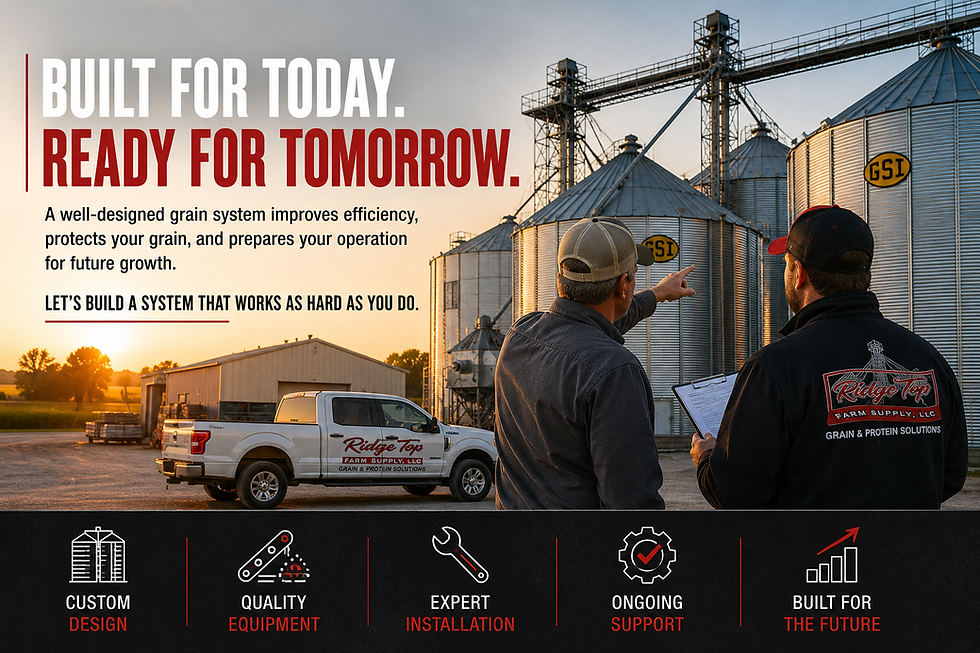
Build a Grain System Around the Way You Farm
A better grain storage system isn't necessarily the one with the most equipment.
It's the one that helps your operation move grain efficiently, protect grain quality, reduce bottlenecks, simplify harvest, and prepare for what's next.
Whether you need one replacement component or you're thinking about a multi-year facility expansion, start with a plan.
RidgeTop Farm Supply serves farmers and agricultural operations throughout Missouri, Southern Iowa, and Eastern Illinois from our location in Memphis, Missouri.
Schedule a grain system consultation with RidgeTop Farm Supply. We'll look at your current setup, discuss where you want your operation to go, and help develop a practical solution for today and the future.
Call (660) 945-3120 or request a free quote to get started.
Safety Note: Grain storage and handling systems involve mechanical, electrical, structural, combustible-dust, and grain-entrapment hazards. Follow manufacturer instructions and applicable safety requirements. Maintenance and specialized installation or repair work should be performed by qualified personnel where required.


Comments